
14 August 2026
My son loves marble runs, but as he became more interested in Lego than the bigger Duplo bricks, I needed a marble run for Lego. So I printed one. This is a rather simple project, but I stumbled onto an interesting physics detail that I wanted to discuss.
Most of you probably just want to watch the video, but if you want to dive into the physics with a proper mathematical description, the blog article is just right for you.
First, let’s get the housekeeping out of the way. If you want to print the marble run, you can get it from any of the following sites:
Also, since I generate the marble tracks using OpenSCAD, you can just download the scad file. All files are shared under the Creative Commons Attribution licence (CC-BY 4.0).
Use 14mm ball bearings as marbles and print the parts you like. You should not need to print supports, and layer height or material should not matter as long as you don’t go too crazy. That’s it.
And now for the physics…
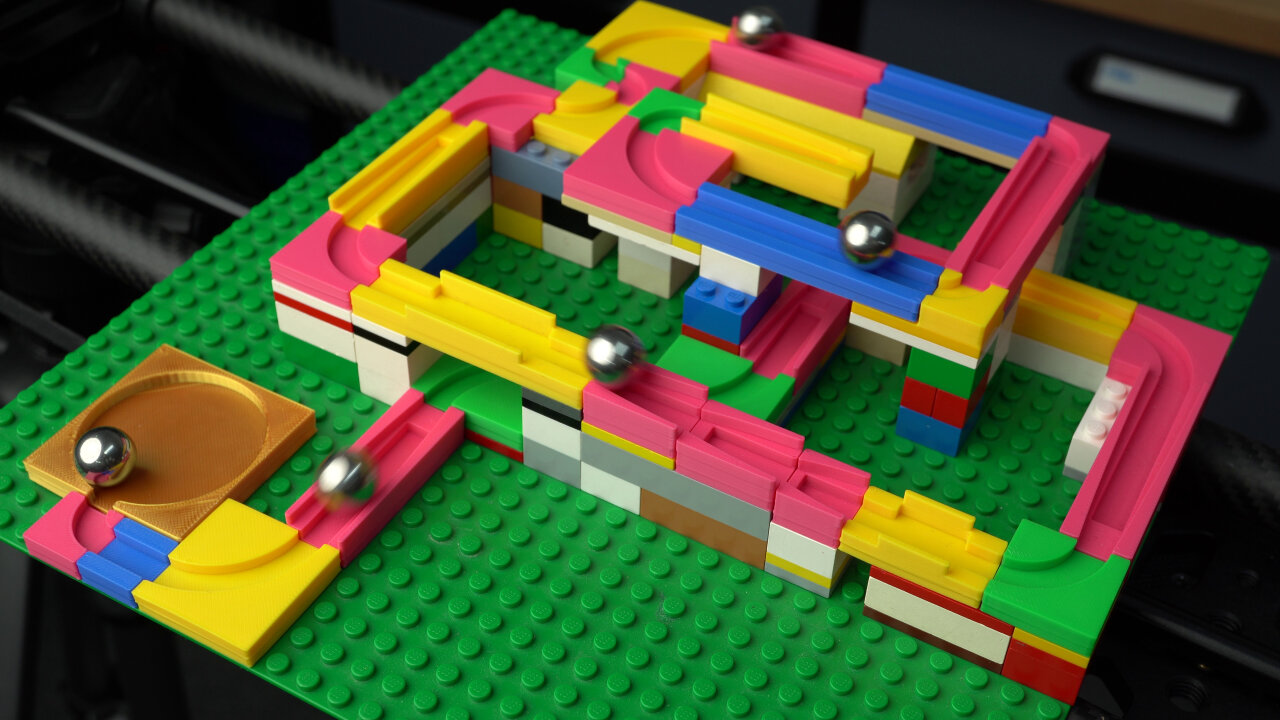
So, why am I even talking about the physics of a simple marble run? Well, it is just an oddity I stumbled upon while designing the tracks.
Normally, you would design some kind of ramp, place the marble at the top and let it go. At the beginning, at a height , the marble with mass has the potential energy (with gravitational acceleration ) and when you let go, potential energy is converted into kinetic energy . If the marble rolls down the entire slope across the height , the entire energy becomes kinetic energy with velocity :
That’s what you might have learned in school, right? Well, depending on how advanced your physics course was, you might also have learned that this is not correct for a solid object. It is only correct for a point mass, a theoretical construct where all mass of the object sits in a single point. If the object has an actual size (like any real object), kinetic energy does not only come from the speed of the object’s center of mass, but also from its rotation. The famous is actually only the translational kinetic energy , but there is also rotational kinetic energy :
These formulas look very similar in form, but rotational energy depends on the rotational counterparts: Velocity becomes angular velocity (in radians per second) and mass becomes the moment of inertia . Resisting the urge to go on a long tangent about the moment of inertia, we can just note that for a solid sphere (like a marble) with radius , the moment of inertia is
Taking into account that the speed of the marble is , we can express the rotational energy in terms of radius and velocity, just like the translational energy:
Which leads to a fixed ratio of translational and rotational energy:
In other words: Even for a marble on a regular slope, a part of the energy goes into the rotation, leaving less energy “for the speed”.
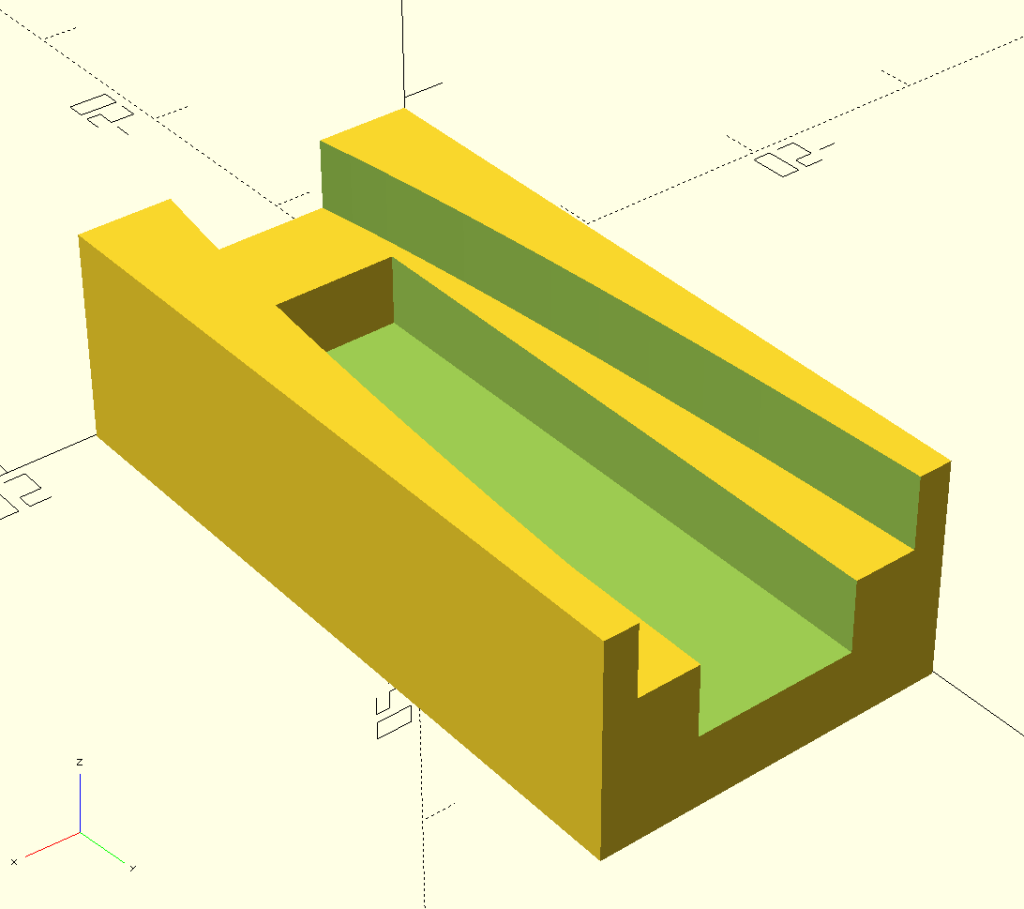
But I did not want to print a slope. I planned for slopes that would work across a third of a Lego brick’s height (the flat Lego bricks), so I would need a rather gentle slope, which is tricky to print. So, instead I decided to design rails (or rather just a gap) that widen along the track. As the rail distance increases, the marble sinks deeper between the rails, its center of mass sinks deeper and once again, it accelerates as its potential energy is converted into kinetic energy. Just like a marble on a sloped track, right?
Not quite. There is a small difference. is universal. That’s still correct. And so is because we are still looking at a solid sphere. But does not apply!
As the marble sinks between the tracks, it rolls about a smaller effective radius . The marble touches the two rails at . Both contact points lie on a sphere with the marble’s radius , so the distance from the marble’s spin axis (through its center) to the contacts is not but
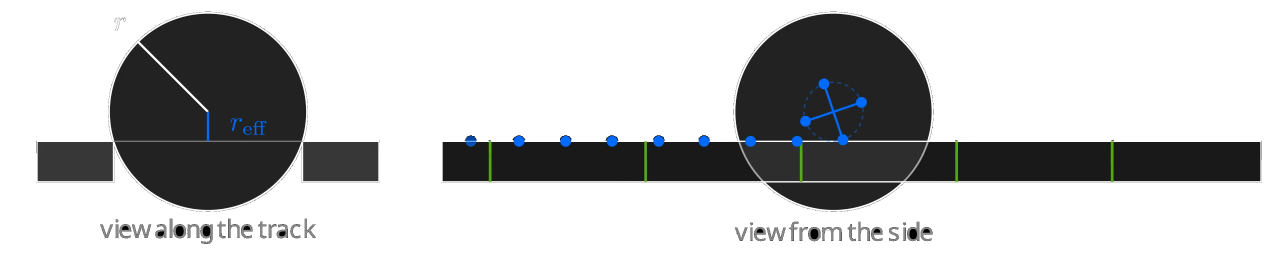
So, our marble still has the same velocity , we still have the same translational energy. And at the same angular velocity , we still have the same rotational energy. But the link between and has changed from to , resulting in a different ratio of the two forms of kinetic energy:
The ratio is tuned by the rail distance . If is zero, we get and are back to the behavior of a marble running on a flat surface. But what happens if ?
As the rail distance becomes larger and larger, the effective radius becomes smaller and smaller. In terms of energy, most energy now goes into rotational energy. Visually, the marble only moves a small distance per rotation, so it has to spin really fast to achieve the same velocity as before.
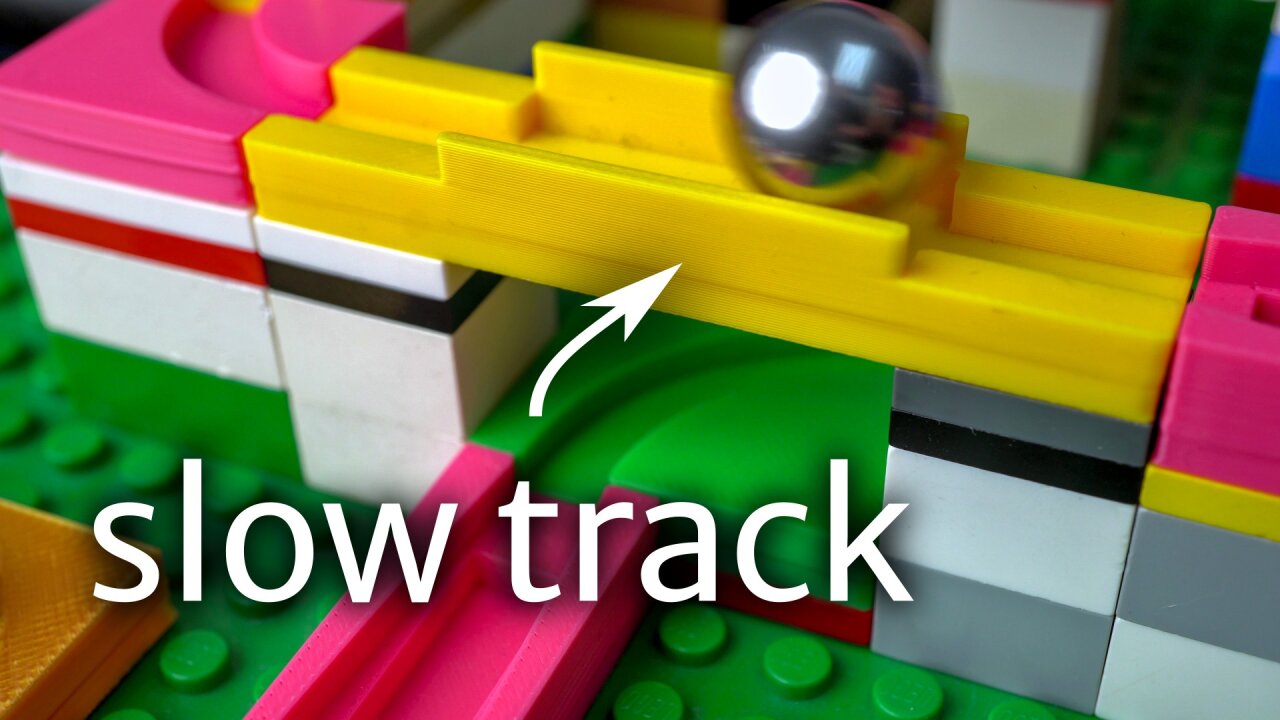
We can use this to create slow tracks. If we support the marble with different rail distances, such that its center of mass remains at the same height (so, wider rails need to be higher to support the marble), we still have the same total energy - the energy that was potential energy when we let go of the marble at the top of our marble run. But with different rail distances, the same energy is distributed across translational and rotational energy differently, leading to different velocities.
If we assume no slippage and no friction, the total energy remains the same. So, we could have a fast-spinning marble that barely moves forward on a wide rail distance, and then have it suddenly speed up when moving onto close rails where it is almost rolling on a surface.
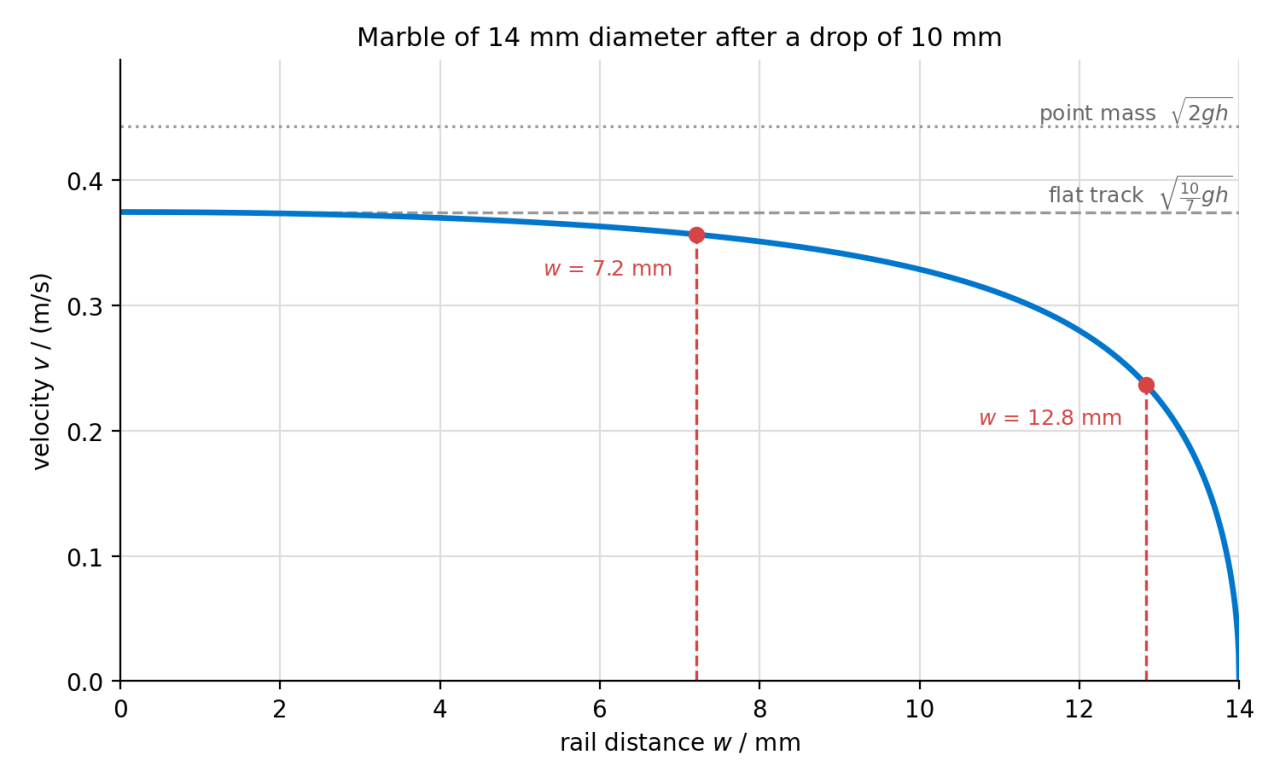
At the limit , the marble no longer moves, but rotates in position. Of course, at that point it is clear that we will not see that in reality. The problem is of course friction. Our intuition already expects that the marble will just get stuck between the rails. And the reason is again a geometrical one. When the marble is rolling on the top of a surface, it experiences rolling resistance, which is proportional to the normal force acting on the marble. When it is more or less stuck between the rails, not only can it be disputed if this is still rolling resistance or rather sliding friction (which is a stronger opposing force), but also the surface now has to apply a much stronger normal force to counter gravity as it has to do so at an angle. Friction becomes really strong and our marble comes to a halt.
So, yeah, do not expect too much from those slow tracks. I did not widen the tracks enough to get more than a subtle effect, because otherwise we would lose our precious kinetic energy to friction.
Hope you enjoyed the little physics lesson - or just the marble run. See you for the next project.
My favorite. Well, have not heard anything bad about printables.com. Please don’t tell me about it. ↩
The old big one. If you want to learn how to lose being the dominant platform, have a look at thingiverse. Still plenty of reach. ↩
How I hate myself for including them. I bought a Bambulab printer and wish I had not. No, the machine is fine (if you ignore that I got one of the first that do not spontaneously burn and die), but that company goes against everything I believe in. If you follow this blog, you certainly know that I love open source, open platforms and open APIs. Since I got the printer, I could witness how Bambulab closes down their APIs, sues (or threatens to sue?) open source developers, violates open source licenses and does everything they can to build a walled garden. Oh, and that platform is full of AI slop and stolen models that users upload because of the incentive of free filament. ↩